Content SEO and writing
Keyword Clustering: How to Group Keywords Without Paid Tools
A manual SERP overlap method to group keywords into pages, so you write one strong page per intent instead of many competing ones.
Read article
This guide is for writers, editors and site owners who see a red passive voice warning in their SEO plugin and wonder whether it matters for rankings. You will learn what Google says about writing style, why passive voice SEO warnings exist, and a quick way to decide which passive sentences to fix and which to keep.
Passive voice does not hurt SEO directly. Google has no rule about it, and the 10% passive limit in plugins like Yoast is a readability guideline. Too much passive voice can hide who does what and make sentences longer, which hurts readers. Rewrite passive sentences in instructions, promises and key answers, and keep the rest.
Nothing specific. Google’s guidance on creating helpful, people-first content does not mention passive voice, sentence length or any readability score. What it does ask is whether the content has “any spelling or stylistic issues” and whether it is “produced well, or does it appear sloppy or hastily produced”. It also treats writing to a target word count as a warning sign, saying plainly that Google does not have a preferred word count.
So there is no passive voice ranking factor to optimise. The real question is whether your sentences are clear enough that a reader, and an AI system quoting you, understands them at once.
Because their readability checks follow plain language advice, not Google rules. Yoast’s check, for example, recommends passive voice in “a maximum of 10% of your sentences”, turning green below 10% and red above 15%. Those thresholds are the plugin’s own guideline. A green bullet does not mean better rankings, and an orange one does not mean a penalty.
The advice behind the check is sound, though. The US government’s plain language guidance on digital.gov says “active voice makes it clear who should do what” and notes that passive sentences “often do not identify who is performing the action”.
| Source | What it says about passive voice | Is it a ranking rule? |
|---|---|---|
| Google helpful content guidance | No mention; asks about stylistic issues and production quality | No |
| Yoast SEO readability check | Maximum 10% of sentences, red above 15% | No, plugin guideline |
| Digital.gov plain language | Use active voice; passive sometimes appropriate | No, writing guidance |
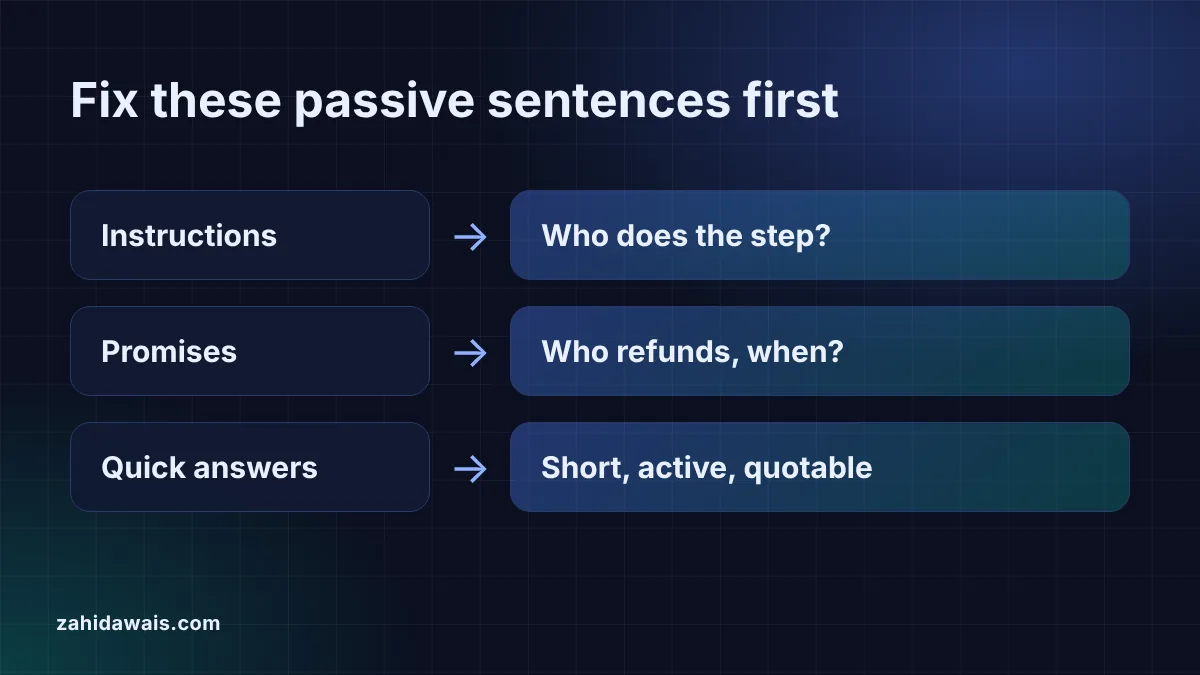
It hurts when the reader needs to know who acts. Three places matter most on business and SEO sites:
Keep it when the doer is unknown, obvious or unimportant, or when the thing acted on is the real topic. “The site was launched in 2020”, “Your order was shipped on Monday” and “The page was indexed within a day” all read naturally. Digital.gov itself accepts that “in a few instances, passive voice may be appropriate”. Forcing every sentence into the active voice can make text sound stiff or put a vague “we” in front of everything.
Paste your draft into the passive voice checker. It highlights each sentence built from a form of “to be” plus a past participle, shows the passive share and, when the sentence names the doer after “by”, tells you who to move to the front. Fix the sentences in instructions, promises and quick answers first. Then run the text through the sentence length checker, because rewriting passive sentences often shortens them, and long sentences are the other big clarity problem.
For a full picture, compare the result with the readability score checker. Treat all three as editing aids, not targets.
Example: a 6 sentence paragraph about an SEO audit had 3 passive sentences, a 50% passive share. “The audit was completed in two days” became “We completed the audit in two days”. “Several broken links were found by the crawler” became “The crawler found several broken links”. “The new sitemap is being tested now” became “We are testing the new sitemap now”. The passive share dropped to 0%, and the paragraph lost 2 words without losing any information.
No. Google publishes no rule about passive voice and its helpful content guidance does not mention it. Google asks whether content is clear and well produced, so fix passive sentences when they make the text unclear, not to please a plugin score.
Yoast’s readability check recommends that no more than 10% of sentences use the passive voice. It is a writing guideline built into the plugin. Your rankings do not change when the bullet turns from orange to green.
There is no official number. Many writers aim for about 10%, the Yoast default, but technical, legal and scientific writing often uses more for good reasons. Judge each sentence by whether the reader knows who acts.
No source says it does directly. Clear, short, self contained sentences are easier for any system to quote accurately, so active sentences in your quick answers and key definitions are a sensible choice for AEO and GEO.
No. “Google crawled the page” is past tense and active. “The page was crawled by Google” is passive. Passive voice needs a form of to be plus a past participle, whatever the tense.
Only when you update a post for other reasons, or when a key passage is unclear. Rewriting style alone rarely moves rankings. Focus updates on accuracy, missing information and better answers to the questions people search for.
This guide is part of my SEO content writing guide.
Checked 22 Oct 2026. Facts checked against these official pages. Read how I check facts in my editorial policy.
Need articles or page copy written for readers and search? See my content writing service.
A manual SERP overlap method to group keywords into pages, so you write one strong page per intent instead of many competing ones.
Read article
A practical refresh checklist for old posts, covering what to change, when to update the date and when a URL change is worth it.
Read article
Fifteen concrete ways to show experience, expertise, authority and trust, with before and after rewrites you can apply to any page today.
Read articleSend your website and I will reply with a free audit.