Keyword Extractor from Text
A keyword extractor is a tool that pulls the most important terms out of a text. This one splits the text at…
Paste a page or draft to list the people, organizations, places and other entities it names, with counts and schema suggestions.
This is a heuristic, not an NLP model: it uses capital letters, word lists and patterns, so check every row. It works best on English text and runs in your browser.
| Entity | Likely type | Mentions | Suggested use |
|---|
The free entity extractor lists the people, organizations, places, products and acronyms a text names, plus dates, prices, URLs and emails, counts how often each appears and suggests which ones fit the schema.org about, mentions and sameAs properties. It is a rule based heuristic that runs in your browser.
An entity extractor lists the named things in a text, such as people, organizations, places and acronyms, plus dates, prices, URLs and emails. This one uses pattern rules in your browser, not an NLP model, so check each row. Use the main entity for schema about, others for mentions, and profile URLs for sameAs.
An entity extractor is a tool that finds the named things in a piece of text and lists them with a type and a count. In SEO, entities are the people, organizations, places, products and concepts a page is about or refers to. Listing them shows whether a page names its main subject clearly and consistently, and gives you the raw material for structured data.
Schema.org has a property for each job. about is "the subject matter of an object", while mentions "indicates that the CreativeWork contains a reference to, but is not necessarily about a concept". The sameAs property holds the "URL of a reference Web page that unambiguously indicates the item's identity", such as a Wikipedia page, a Wikidata entry or an official profile. This tool sorts its findings into those three uses so you can decide quickly.
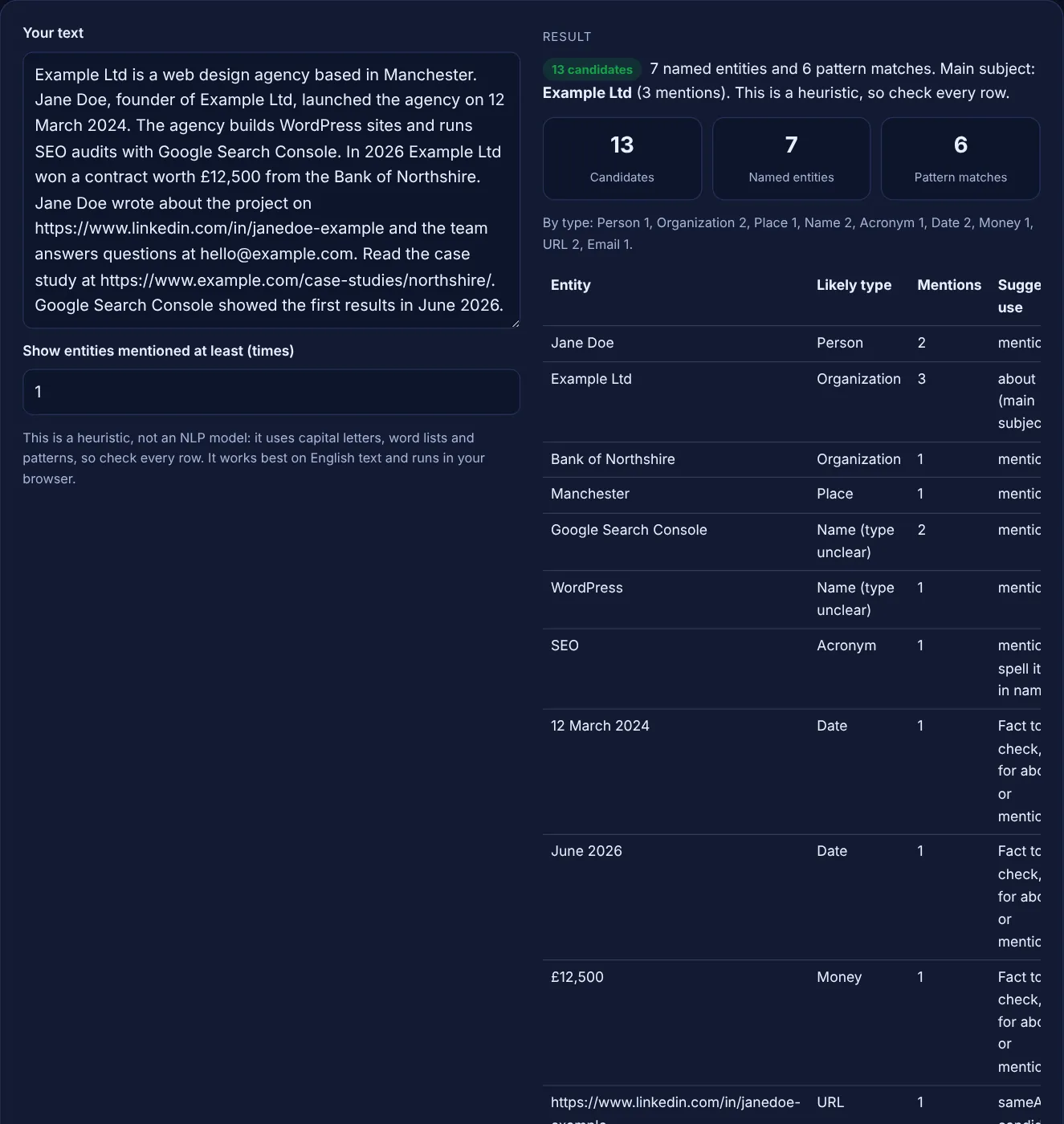
It uses rules, not a trained language model. First it takes out patterns it can match exactly: URLs, emails, dates such as 12 March 2024 or 2026-11-06, and amounts with a currency sign or code. Then it joins runs of capitalised words into names, allowing small linking words such as of and for, so "Bank of Northshire" stays one entity. Single capitalised words at the start of a sentence are skipped unless the same word is also capitalised mid-sentence. Words in capitals, such as SEO, are listed as acronyms.
Types come from clues around the name. Endings such as Ltd, Inc or University suggest an organization, a title such as Dr or a following word such as said or founder suggests a person, and phrases such as based in suggest a place. Everything else is labelled Name (type unclear). That honest label is the point: a human decides.
Put the one main subject of the page in about, other important named things in mentions, and links to official profiles of an entity in that entity's own sameAs. The tool picks the named entity with the most mentions as the about candidate, which is often right on an about page or a profile and often wrong on a broad article, so decide yourself. Dates, prices and emails are facts to check, not entities for about or mentions.
sameAs links belong in the Organization or Person markup that describes that entity, not in the page's about block. Google's Organization structured data documentation describes sameAs as "the URL of a page on another website with additional information about your organization", and its article documentation says Google "can understand both sameAs and url when disambiguating authors".
Treat it as a clarity task, not a ranking trick, because no ranking benefit is promised for listing entities in about or mentions. Google does say that Organization markup on the home page can help it "disambiguate your organization in search results" and pick the logo for knowledge panels. Clear, consistent names in the visible text matter first. Markup only describes what the page already says, so never add an entity that the page does not mention.
| Likely type | Rule used | Example | Suggested use |
|---|---|---|---|
| Organization | Ends in Ltd, Inc, Group, University and similar, or starts with Bank, Council | Example Ltd | about or mentions |
| Person | Title such as Dr, or followed by said, wrote or a role such as founder | Jane Doe | about or mentions |
| Place | After based in or near, or ends in Street, City, County | Manchester | about or mentions |
| Name (type unclear) | Capitalised words with no type clue | Google Search Console | mentions, after you check it |
| Acronym | Two or more capital letters | SEO | mentions, spelled out |
| URL | Starts with http, https or www | linkedin.com/in/... | sameAs if it is an official profile |
| Date, money, email | Fixed patterns | 12 March 2024, £12,500 | Facts to check, not entities |
Example: the default text is a short about page for Example Ltd, a made-up agency. The extractor finds 13 candidates: 7 named entities and 6 pattern matches. Example Ltd appears 3 times, so it is the about candidate, typed as an organization because of the Ltd ending. Jane Doe is typed as a person (2 mentions) because "founder" and "wrote" follow her name, Manchester is a place because it follows "based in", and Bank of Northshire is an organization. Google Search Console (2) and WordPress are names with no type clue, and SEO is an acronym. The patterns are 2 dates, 1 amount, 2 URLs and 1 email, and the LinkedIn URL is flagged as a sameAs candidate for Jane Doe's Person markup.
No. It is a rule based heuristic that uses capital letters, small word lists and patterns. That keeps it fast and private, but it will miss lowercase brand names and sometimes guess the wrong type. Check every row before you use it.
The tool only assigns Person, Organization or Place when it sees a clue, such as Ltd, Dr, said or based in. Without a clue it labels the entity Name (type unclear) instead of guessing, so you can set the right type yourself.
Every sentence starts with a capital letter, so a single capitalised first word is usually not a name. The tool keeps it only when the same word is also capitalised in the middle of a sentence somewhere else in your text.
No. The extractor runs entirely in your browser with JavaScript. Your text is not sent to a server or stored, so you can check client drafts and unpublished pages safely.
Treat it as a starter. Remove entities the page does not really discuss, change Thing to a more specific type where you know it, and add the about and mentions properties to your existing Article or WebPage markup instead of adding a second block.
Partly. Capitalised names and the URL, email and money patterns work in many languages, but the word lists, month names and type clues are English. In German, where every noun is capitalised, results will be noisy.
Checked 23 Oct 2026. Facts checked against these official pages. Read how I check facts in my editorial policy.
A keyword extractor is a tool that pulls the most important terms out of a text. This one splits the text at…
An organization schema generator is a tool that writes schema.org Organization structured data. It gathers…
A person schema generator is a tool that writes schema.org Person structured data. It describes who someone…
Builds Google search strings to find unlinked brand mentions, reviews and citations.
Send your website and I will check it for you, free.
One short email when something new goes live: articles, free SEO tools, package updates, discounts and price alerts. No spam, unsubscribe in one click.