Readability Score Checker
A readability score checker is a tool that estimates how hard a text is to read from sentence length and word…
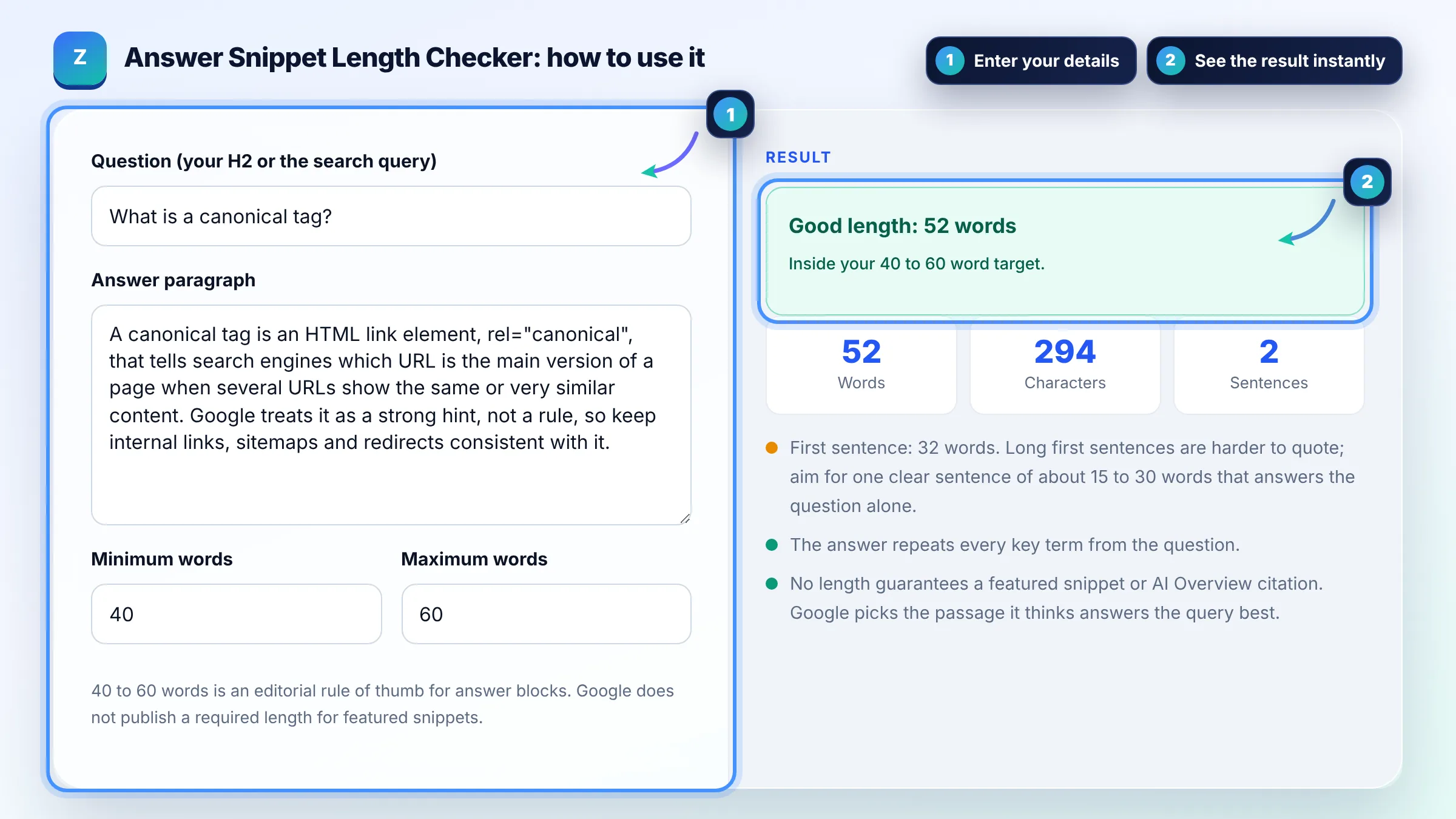
Paste a question and your answer to check its length, clarity and key terms instantly.
40 to 60 words is an editorial rule of thumb for answer blocks. Google does not publish a required length for featured snippets.
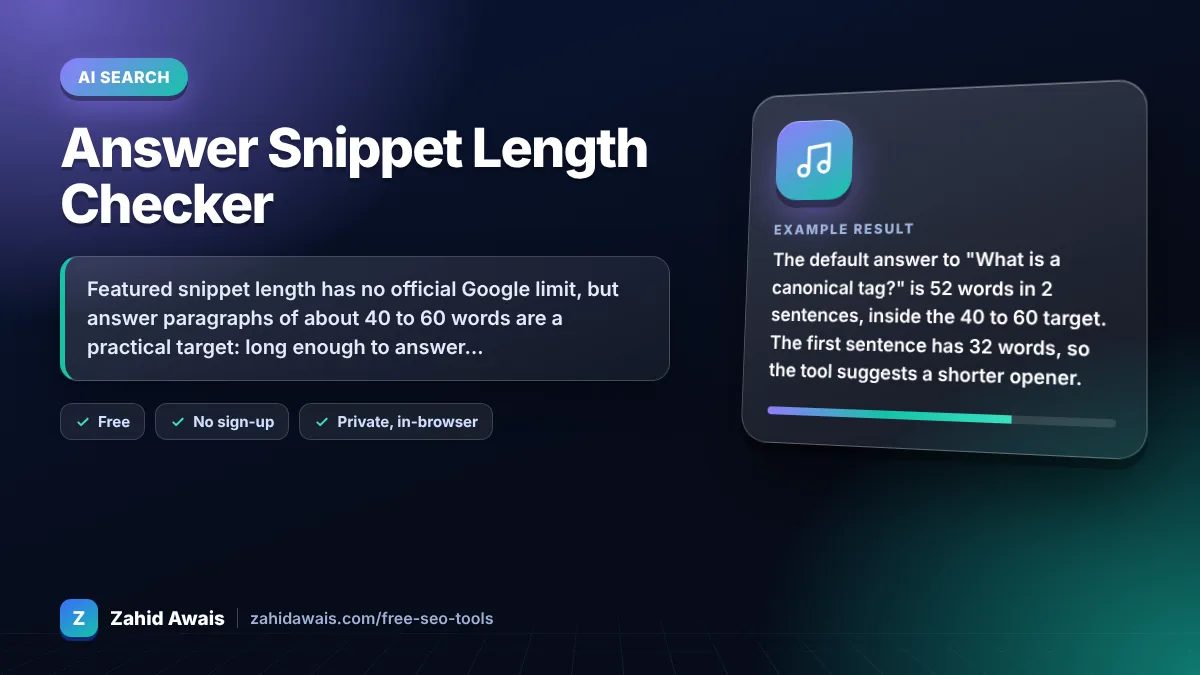
The free featured snippet length runs in your browser, needs no sign-up and never sends what you type anywhere.
Featured snippet length has no official Google limit, but answer paragraphs of about 40 to 60 words are a practical target: long enough to answer fully, short enough to be quoted whole. Put the direct answer in the first sentence, repeat the key term from the question and add one specific number, condition or example.
An answer snippet length checker is a tool that counts the words, characters and sentences in an answer paragraph and compares the count with a target range (40 to 60 words by default). It also checks whether the answer repeats the question's key terms, opens with the answer and avoids phrases that break when quoted alone.
Aim for about 40 to 60 words, but treat it as a rule of thumb, not a Google rule. Google's featured snippets documentation says it does not provide an exact minimum length, and the shown text depends on the information, language and platform. List and table snippets follow the page's structure instead of a word count.
Write clear, standalone answers under question headings, the same way you would for featured snippets. Google says there are no extra requirements or special optimizations to appear in AI Overviews or AI Mode; pages must be indexed and eligible for a snippet. Answer blocks simply make your best passage easy to find and quote.
Yes. A nosnippet rule blocks all snippets for the page, data-nosnippet hides specific text, and a lower max-snippet value reduces featured snippet eligibility while keeping normal snippets. Google notes that max-snippet alone does not guarantee a featured snippet disappears, so use nosnippet when you must be sure.
| Answer type | Practical target | Tip |
|---|---|---|
| Definition (What is X?) | 40 to 60 words | Start with "X is ..." and one key detail |
| How to (short) | 40 to 60 words or a list | Use numbered steps under the heading for list snippets |
| Yes or no | 30 to 50 words | Open with Yes or No, then the reason |
| Comparison (X vs Y) | A table plus a 40 to 60 word summary | Put the deciding difference in the first sentence |
| Cost or number | 30 to 50 words | Lead with the range or figure and what changes it |
Example: the default answer to "What is a canonical tag?" is 52 words in 2 sentences, inside the 40 to 60 target. The first sentence has 32 words, so the tool suggests a shorter opener. Splitting it into "A canonical tag is an HTML element, rel="canonical", that names the main URL of a page." gives a 16 word opener that still reads well when quoted alone.
No. Google does not publish a required length for featured snippets or AI Overviews. 40 to 60 words is a widely used editorial guideline because it fits a complete answer that a search engine can quote without cutting it off. Use it as a target, not a guarantee.
Every question heading benefits from a first sentence that answers it on its own, followed by detail. Not every section needs a strict 40 to 60 word block; tutorials, lists and tables can follow their natural format. The goal is that a reader who sees only that paragraph gets the answer.
They can, but some searchers get what they need from the snippet itself. Pages that answer briefly and then promise more depth, such as steps, examples or a tool, give people a reason to click. Check clicks and CTR for those queries in Search Console before and after.
No markup is required for featured snippets. Google's systems decide which page makes a good featured snippet for a query, and site owners cannot request one. Clear headings, a direct answer and helpful content matter more than any schema type.
Search the query in a private window and look for your page in the box above the results, or check rank tracking tools that report SERP features. Results change by location, device and time, so check a few times before drawing conclusions.
Google chooses the passage it believes best answers the specific query, which may not be your planned answer block. Make the intended paragraph sit directly under a heading that matches the query, keep it self contained and make sure nearby text does not contradict it.
Facts checked against these official pages. Read how I check facts in my editorial policy.
A readability score checker is a tool that estimates how hard a text is to read from sentence length and word…
A question keyword generator is a tool that combines your topic with question words (what, how, why, who,…
A headline analyzer is a tool that checks a headline against a checklist and turns it into a score out of…
Send your website and I will check it for you, free.
One short email when something new goes live: articles, free SEO tools, package updates, discounts and price alerts. No spam, unsubscribe in one click.