AI search (AEO and GEO)
How to Control How AI Search Uses Your Content
Control how AI search uses your content: robots.txt tokens for GPTBot, ClaudeBot and Google-Extended, nosnippet and max-snippet for AI Overviews, and llms.txt.
Read article
More SaaS buyers now ask AI tools which software to try before they ever open a search results page. GEO for SaaS companies is the work of making your product easy for those tools to find, understand and cite. This guide shows what the official docs say and a simple method to follow.
GEO for SaaS companies means shaping your site and brand so AI answers in Google, ChatGPT and similar tools can find and cite your product. Google says there are no special requirements for its AI features, so the core is solid SEO: crawlable text, clear product pages, matching structured data and mentions on trusted sites.
GEO for SaaS companies is generative engine optimization applied to software brands: helping AI answer engines describe and link to your product correctly. It sits on top of normal SEO, not in place of it.
A SaaS buyer might ask “which invoicing tool works for a five person agency” or “compare project tools with time tracking”. An AI answer pulls from many pages, then writes a short reply with a few links. GEO is about being one of the pages it trusts and one of the brands it names.
A few terms used in this guide:
If you want the wider picture first, read GEO vs SEO.
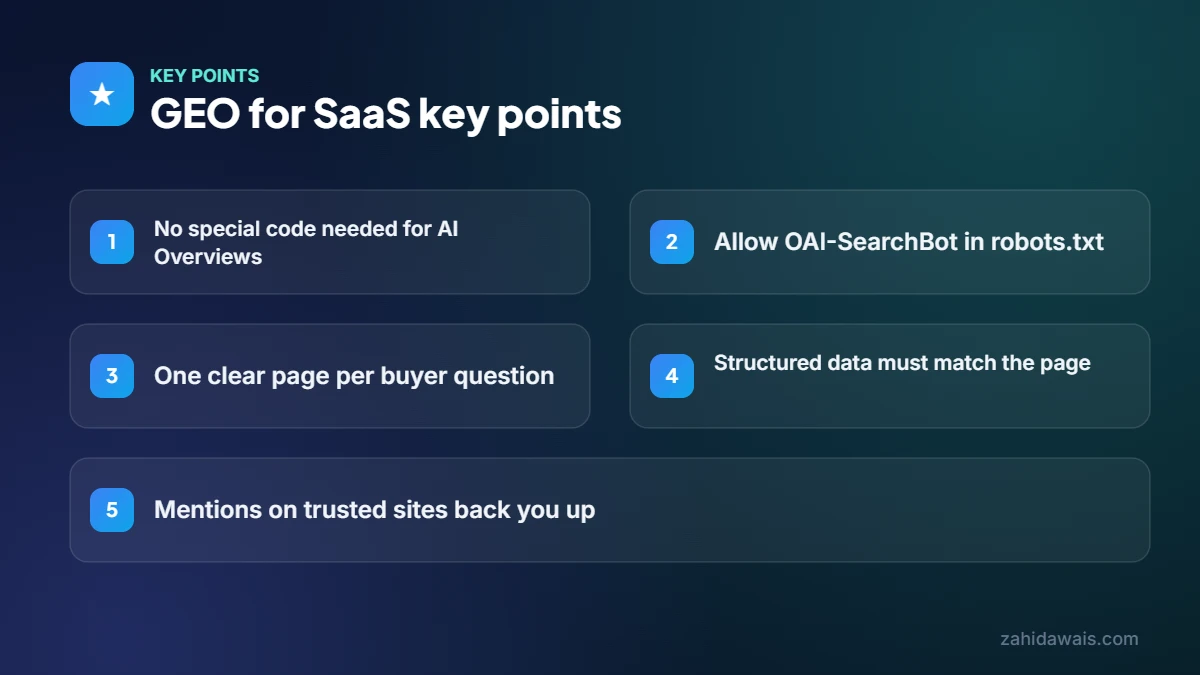
Google says there are no extra requirements to appear in AI Overviews or AI Mode, so normal SEO best practices are the base. Your page must be indexed and eligible to show with a snippet.
Google's page on AI features and your website states: “There are no additional requirements to appear in AI Overviews or AI Mode, nor other special optimizations necessary.” It adds that “You can apply the same foundational SEO best practices for AI features as you do for Google Search overall.”
The same page explains that “Both AI Overviews and AI Mode may use a “query fan-out” technique.” This means one buyer question can trigger searches on several subtopics. For a SaaS brand, that is useful. A question about “best CRM for small teams” may also pull pages on pricing models, integrations and data import. If you have a clear page for each, you have more chances to be used.
Google lists some best practices that matter here:
Google also notes that traffic from AI features is counted in the Search Console Performance report under the Web search type. There is no separate filter, so track your key product pages there over time.
ChatGPT finds pages for its search features through a crawler called OAI-SearchBot, so your robots.txt must allow it. Blocking it can keep your pages out of ChatGPT search answers.
OpenAI's crawler documentation says “OAI-SearchBot is used to surface websites in search results in ChatGPT's search features.” It recommends allowing OAI-SearchBot in robots.txt. A separate crawler, GPTBot, is used for model training. You can block GPTBot and still allow OAI-SearchBot, because they do different jobs.
Many SaaS sites block bots by accident. A security plugin, a firewall rule or an old robots.txt line can stop crawlers from reading docs and pricing pages. Check this first. It costs nothing and it is often the biggest quick fix. My guide on how to get cited by ChatGPT covers more detail, and how AI tools choose sources explains why some pages get picked over others.
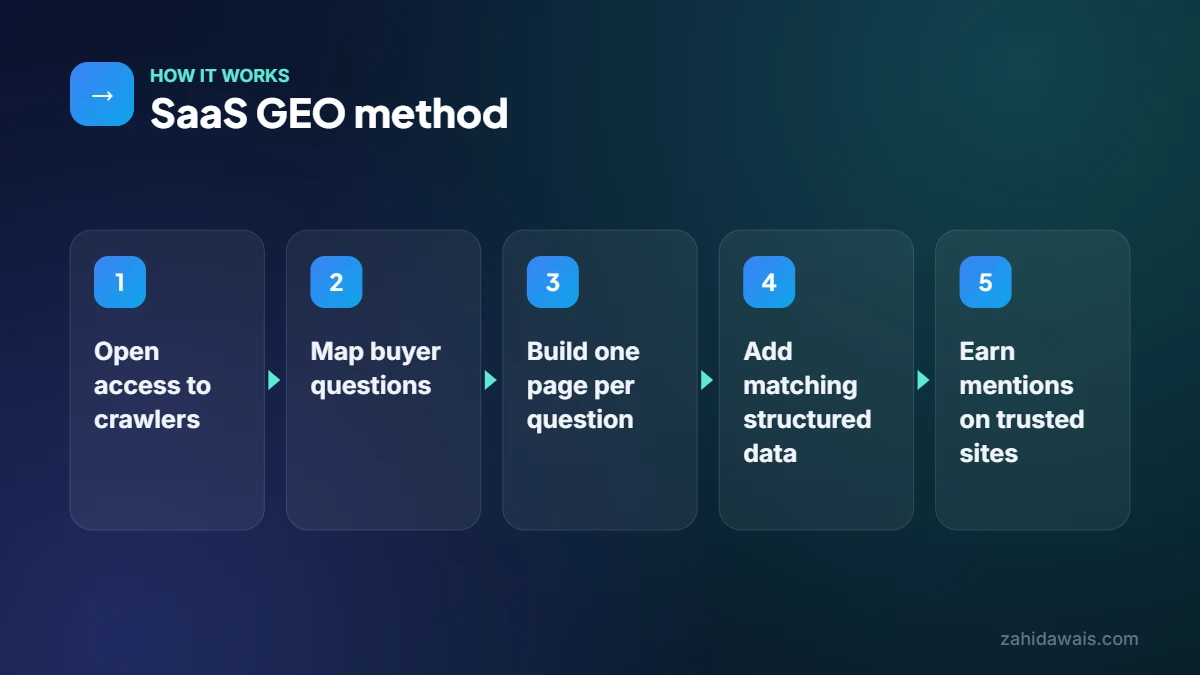
A simple GEO method for SaaS is: open access to crawlers, map buyer questions, build one clear page per question, add matching structured data, then earn mentions on trusted sites.
On structured data, Google's SoftwareApplication documentation lists name, offers.price and either aggregateRating or review as required for a rich result. For a free plan, it says to set the price to 0. Only add ratings that are real and shown on the page. My guide to schema markup for AI search goes further.
The SaaS pages that matter most for AI answers are the ones that answer buyer questions directly: product, pricing, integrations, comparisons and help docs. Each one serves a different kind of query.
| Page type | Buyer question it answers | What to include |
|---|---|---|
| Product or feature page | What does this tool do? | Plain description, main use cases, who it is for |
| Pricing page | How much does it cost and what is included? | Plan names, limits and free trial terms in text |
| Integrations page | Does it work with the tools I use? | A crawlable list of integrations with short notes |
| Comparison page | How is it different from other options? | Fair, factual differences and best fit cases |
| Help docs | How do I set it up or fix a problem? | Step by step text, not only video |
| Security page | Is my data safe? | Data storage, access control and compliance facts you can prove |
Pricing and integrations pages are often built as images or behind scripts. Turn them into readable text. That one change helps both search crawlers and AI tools.
GEO for a single question means building one page that answers it fully, then making sure other sites mention the same facts. Here is an illustration.
This is an illustrative example, not a real company. Example Invoice (exampleinvoice.com) sells invoicing software for small agencies. Buyers often ask AI tools “which invoicing app supports multiple currencies for agencies”. The site has a multi currency feature, but it is only shown in a video on the home page.
The fix has four parts. First, a text page called “Multi currency invoicing for agencies” that answers the question in the first paragraph and lists supported currencies. Second, a link to it from the pricing and features pages. Third, SoftwareApplication markup on the product page that matches the visible plan prices. Fourth, two guest posts on agency and finance blogs that mention the feature by name, with any paid links marked rel=”sponsored”. Now the answer exists in text on the site and is backed by other sources.
Off-site mentions are the part most SaaS teams skip. A SaaS guest post on a relevant blog puts your product name and facts in a second place AI tools can read. Paid placements must carry rel=”sponsored”, as Google's link spam policy asks.
If you want a full plan built around your product, my GEO services page explains how I can help.
GEO builds on SEO rather than replacing it. Google says the same foundational SEO best practices apply to its AI features. GEO adds focus on clear answers, crawler access for AI tools and brand mentions on other sites.
No. Google says there are no additional requirements or special optimizations needed for AI Overviews or AI Mode. Your page must be indexed and eligible to show with a snippet in Google Search.
That is a business choice. GPTBot is used for model training, while OAI-SearchBot surfaces sites in ChatGPT search. OpenAI documents them separately, so you can block GPTBot and still allow OAI-SearchBot.
Structured data helps Google understand your product, and Google asks that it match the visible text. For software, SoftwareApplication markup needs name, offers.price and a rating or review to be eligible for a rich result.
Google counts AI feature traffic in the Search Console Performance report under the Web search type. Track product, pricing and comparison pages there, and also note when AI tools name your brand for key buyer questions.
SEO results usually take 3 to 6 months, and GEO follows a similar pace because it depends on crawling, indexing and mentions building up. Quick fixes like opening crawler access can help sooner.
Facts checked against these official pages. Read how I check facts in my editorial policy.
Control how AI search uses your content: robots.txt tokens for GPTBot, ClaudeBot and Google-Extended, nosnippet and max-snippet for AI Overviews, and llms.txt.
Read article
What an entity home page is, which page to use for a brand or person, what to put on it, which schema…
Read article
How AI tools choose sources, from official docs only: how ChatGPT search, Google AI Overviews and AI Mode, and Perplexity find, pick…
Read articleSend your website and I will reply with a free audit.