Link building strategy
Backlinks Not Improving Rankings? 10 Reasons and How to Fix Them
When links go live but positions stay flat, the cause is usually the links, the page or the timeline. Here is how to tell.
Read articleLocal links come from real relationships in your area. These ideas turn things you already do into links Google can see.
This article gives you practical local link building ideas for small businesses, ranked by effort and value, plus a 90 day plan and the local tactics I would skip because they cross Google’s link spam lines.
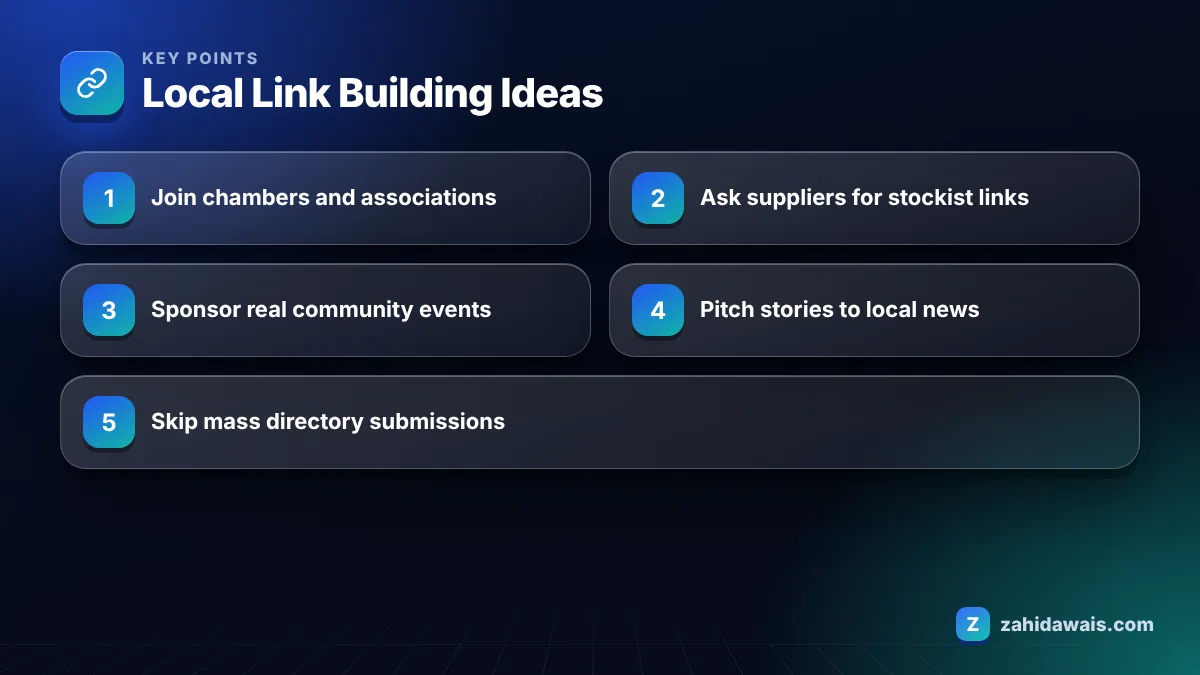
The best local link building ideas come from real local relationships: chambers of commerce, trade associations, suppliers, community sponsorships, local news, events, schools and neighbouring businesses. These links are relevant to your area, hard for distant competitors to copy, and support the prominence Google considers in local results. Avoid paid link schemes and mass directory submissions.
Local links matter because Google uses prominence, meaning how well-known a business is, as one of the three main factors for local results, alongside relevance and distance. Google’s help page on improving your local ranking says prominence depends partly on how many websites link to the business and on its reviews.
Local links also send real customers. A link from your town’s community news site or your supplier’s “where to buy” page brings visitors who are already nearby and interested, which no generic guest post can match.
From the local clients I have worked with, the businesses that win the map pack rarely have huge link counts. They have a modest number of links from places that clearly belong to their area and industry.
You get local backlinks by looking at the relationships your business already has, such as suppliers, memberships, sponsorships, customers and neighbours, and asking whether each one has a website that could mention you. Most small businesses already qualify for 5 to 10 local links they have never claimed.
Here are 15 ideas I use with local clients:
Local citations count as backlinks only when the listing includes a clickable link to your website; a citation is any mention of your business name, address and phone number, with or without a link. Many directory links also carry nofollow, which Google says will generally not be followed, but they still help customers find and verify you.
Citations are worth having on major platforms and directories relevant to your country and industry, with consistent details everywhere. Hundreds of low quality directory submissions are not. Google’s link spam policies list low quality directory or bookmark site links among their examples of link spam.
Your Google Business Profile matters more than any directory. My local SEO service covers the profile, citations and reviews together, since they work best as one system.
The best local link building strategies are the ones that combine relevance to your area with a genuine reason for the link to exist, such as memberships, partnerships, sponsorships and local PR. This table compares the main options by effort and value.
| Idea | Effort | Typical cost | Local value |
|---|---|---|---|
| Chamber or association listing | Low | Membership fee | High relevance, trusted |
| Supplier “stockist” page | Low | Free | Medium to high |
| Community sponsorship | Medium | Small to moderate | High, plus goodwill |
| Local news story or quote | Medium | Free | High |
| Hosting an event | Medium to high | Varies | High, several links at once |
| Local resource or guide | Medium | Your time | Medium, lasting |
| Mass directory submissions | Low | Cheap | Low, possible spam |
Note on sponsorships: if a sponsor link is given in exchange for money, Google’s policies expect it to be qualified, typically with rel=”sponsored”. The local value comes mostly from the relationship, visibility and referral visits, so do not sponsor something only for the link.
Ask local organizations for a link in person or by a short, friendly email that refers to your existing relationship and makes the request easy, such as “could you add our website to the members page?” Local contacts respond far better than strangers, because they already know you.
What works in my experience with local clients:
Keep a simple list of every local organization you deal with and review it each quarter. New sponsorships, events and partnerships appear all the time, and each one is a fresh chance for a relevant local mention. Over a year, this habit alone often produces more useful local links than any paid campaign.
Here is a worked example for an independent bakery. Days 1 to 30: join the local chamber (1 link), ask 2 flour and coffee suppliers to list the bakery on their stockist pages (2 links), and fix the Google Business Profile and 5 key citations. Days 31 to 60: sponsor a primary school bake sale, listed on the school’s news page (1 link, marked sponsored), and pitch a story to the local paper about the bakery’s apprentice scheme (1 link). Days 61 to 90: publish a “best picnic spots in town” guide with the bakery’s picnic boxes, shared with 2 local bloggers (2 links). Total: 7 relevant local links in 90 days, most of them free, plus real visitors from each.
Avoid any local tactic that creates links without a real relationship behind them, such as buying links on fake “city news” sites, joining link exchange groups, or paying for hundreds of directory submissions. Google’s link spam policies describe these patterns, and they rarely help the map pack anyway.
To see how I combine on-page work and link building for a real business, read my UK travel company case study. If you want help finding and earning local links, my link building service can add relevant regional placements alongside the local work, with honest reporting and no ranking promises.
There is no fixed number. Many small businesses compete well with a modest set of relevant local links from chambers, associations, suppliers and local media. Compare the businesses already appearing in the map pack for your main service and city to set a realistic target.
Sponsoring local events is fine, but if a link is given in exchange for payment, Google’s spam policies expect it to be qualified with rel=”sponsored” or nofollow. The main value of local sponsorships is visibility, goodwill and referral visits rather than ranking credit.
Google’s local ranking help page says prominence depends on links to the business and on reviews, with more reviews and positive ratings helping. Both matter. Reviews also influence whether searchers choose you, so build them alongside local links.
Usually not. A handful of major platforms and industry directories relevant to your country are worth claiming with consistent details. Bulk submission services often use low quality directories, which Google’s link spam policies list as an example of link spam.
Yes. Service area businesses can still earn links from local associations, suppliers, sponsorships and local media in the areas they serve. These links show relevance to the area, even if the Business Profile hides the address.
List every supplier, association, partner, charity and community group you already work with, then check which have websites that mention businesses. Search your city with words like sponsors, members or stockists to find more pages listing local companies.
Facts checked against these official pages. Read how I check facts in my editorial policy.
When links go live but positions stay flat, the cause is usually the links, the page or the timeline. Here is how to tell.
Read article
Backlinks pass through crawling, indexing and re-evaluation before rankings move. Here is what each stage looks like in practice.
Read article
A new site needs a few trusted links, not a big package. This month by month plan shows what to build and when.
Read articleSend your website and I will reply with a free audit.