Fintech and Crypto Link Building on Finance and Tech Sites
Fintech and crypto link building on trusted finance, tech and blockchain sites. YMYL aware site checks, rel="sponsored" links and no gambling niches.
Finance and crypto sites are judged harder than most sites on Google. I offer fintech link building that places your brand on real finance, tech and blockchain publications, with every paid link marked the way Google asks. The goal is links that help trust, not links that put it at risk.
Fintech and crypto link building means earning or placing links on finance, tech and blockchain sites that real readers trust. Because these topics are YMYL, Google expects strong trust signals. I pick niche relevant sites, check traffic and editorial quality, mark paid links rel="sponsored", and never work with gambling, casino or betting brands.
Why is link building different for fintech and crypto?
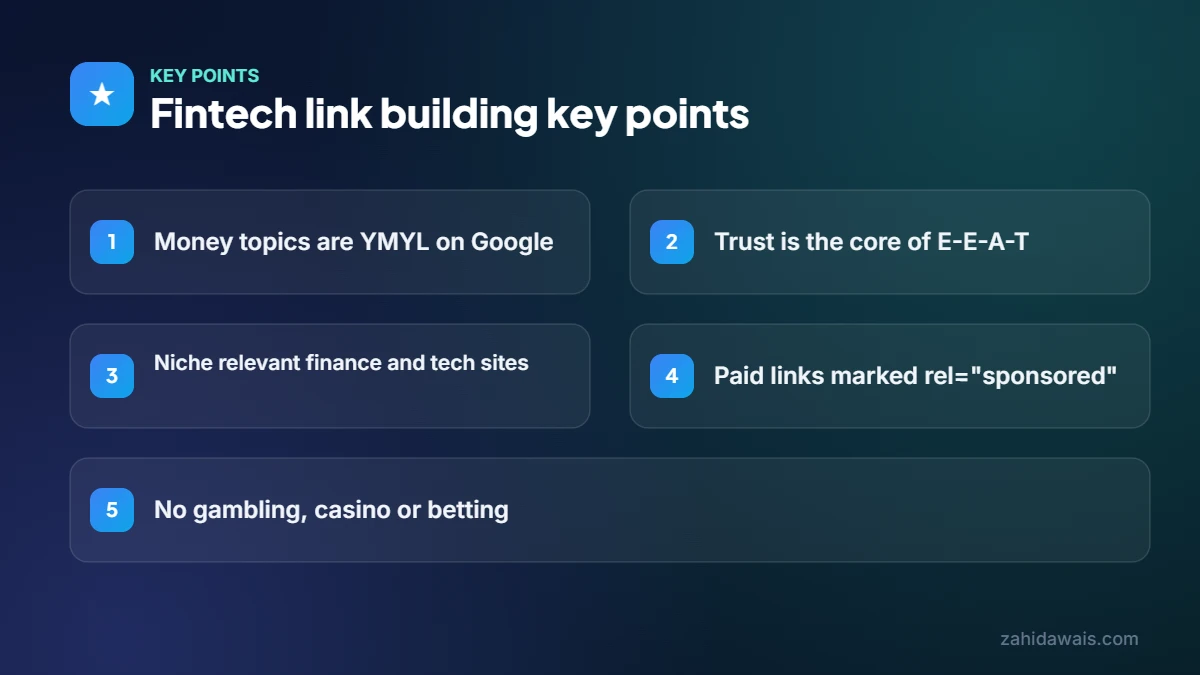
Link building is different for fintech and crypto because Google treats money topics as YMYL, so trust matters more than volume. One weak link profile can hold back a finance brand longer than it would hold back a hobby blog.
Google explains this in its guide to creating helpful, reliable, people-first content. It says some topics "could significantly impact the health, financial stability, or safety of people." It calls these "Your Money or Your Life" topics, or YMYL. Payments apps, lending tools, trading platforms, wallets and exchanges all sit close to that line. A reader can lose real money if the content is wrong.
That changes how I build links for these brands. Fewer, better placements beat a long list of cheap ones. Every site has to make sense for a reader who cares about money. If a page would look odd to a careful reader, it does not go on the list.
Some key terms used on this page:
- Fintech: financial technology, such as payment apps, neobanks, lending software and budgeting tools.
- Blockchain: the shared ledger technology behind crypto assets, wallets and exchanges.
- YMYL: Google's label for topics that can affect a person's health, money or safety.
- E-E-A-T: experience, expertise, authoritativeness and trustworthiness, the qualities Google's systems look for.
- Quality rater guidelines: the document Google gives human raters who assess search results.
- rel="sponsored": the link attribute Google asks you to use on paid links.
What do Google's E-E-A-T and YMYL rules mean for finance links?
For finance links, E-E-A-T and YMYL mean your links should come from places that are trusted, relevant and honest about what they publish. Trust is the part Google stresses most.
Google's helpful content guide names the four parts of E-E-A-T and then says: "Of these aspects, trust is most important." The Search Quality Rater Guidelines say the same thing in plain words: "Trust is the most important member of the E-E-A-T family." The guidelines also name a YMYL type called Financial Security. They describe it as topics that "could damage a person's ability to support themselves and their families." They use examples such as how to invest money, filling out tax forms and saving for retirement.
Raters do not set rankings directly. Their notes help Google judge whether its systems are working. Still, the guidelines show what Google means by a trustworthy page. In practice, for a fintech or crypto brand, this points to three link rules:
- Links should sit on sites that publish careful, accurate finance or tech content.
- The page around your link should be useful on its own, not a thin advert.
- Your own pages should show who you are, who wrote the content and how readers can reach you.
Links do not replace on-site trust. If your landing page hides its licensing details or authors, a good link only sends people to a weak page. I cover the on-site side in my E-E-A-T guide.
How do I choose sites for fintech and crypto links?
I choose sites for fintech and crypto links by checking topic fit first, then real traffic, editorial standards and outbound link habits. A site must pass every check, not just a metric.
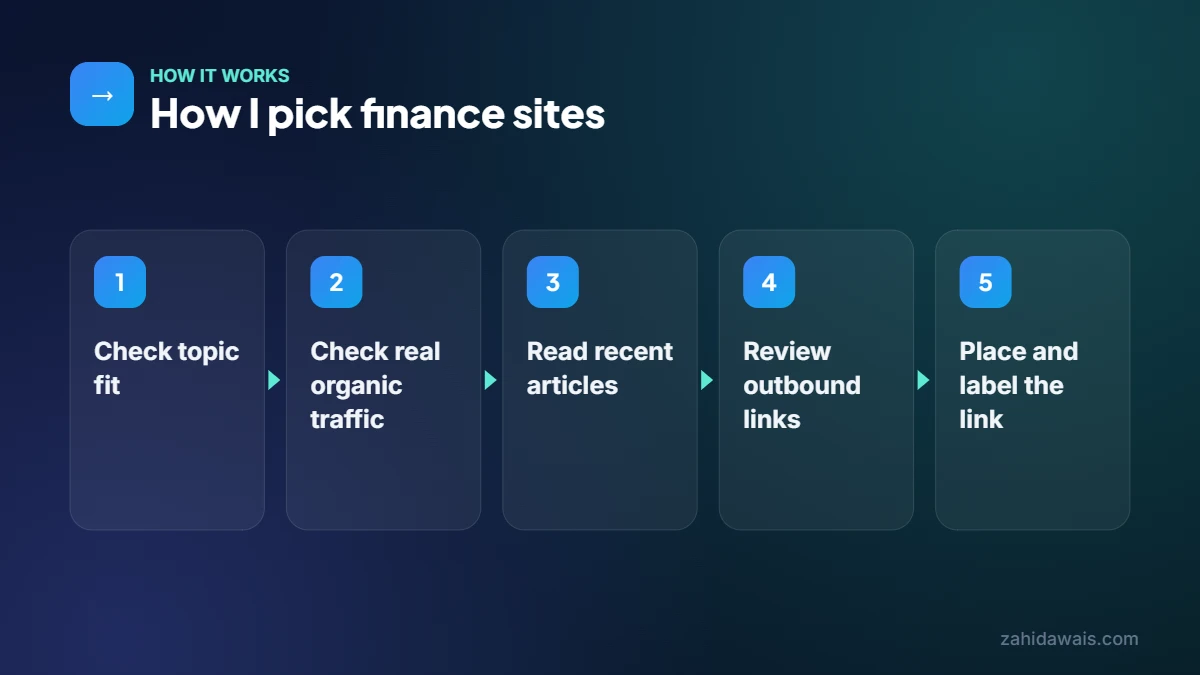
- Topic fit. I look for sites that already cover finance, banking, payments, startups, software or blockchain. Niche relevant sites come first. If none fit, I use general sites with a real finance or business category.
- Real readers. I check that organic traffic is stable and comes from the countries your customers live in.
- Editorial quality. I read recent posts. They should be accurate, written for people and free of copied or spun text.
- Outbound link habits. I skip sites where most posts link to gambling, adult or pill pages. A finance link next to a casino link sends the wrong signal.
- Placement and labelling. The link goes in the body of a useful article, with natural anchor text, and paid placements carry rel="sponsored".
The table below shows how I score a site during review.
| Check | Pass | Fail |
|---|---|---|
| Topic | Finance, fintech, tech or blockchain section with regular posts | No finance content, or a random mix of every topic |
| Traffic | Steady organic traffic from target countries | Sudden drops or traffic from unrelated regions |
| Content | Accurate posts with named authors | Thin, spun or copied articles |
| Outbound links | Links to relevant, legitimate sources | Many links to casino, betting or adult pages |
| Link label | Paid links carry rel="sponsored" | Site refuses to label paid links |
| Indexing | Site and recent posts are indexed on Google | Recent posts not indexed |
For a deeper version of these checks, read how to check guest post site quality.
Are paid links allowed for finance brands?
Paid links are allowed when they are labelled with rel="sponsored" or rel="nofollow". Unlabelled paid links that try to pass ranking credit break Google's link spam policy.
Google's spam policies list "Exchanging money for links, or posts that contain links" as link spam. The same page says paid links are fine "as long as they are qualified with a rel="nofollow" or rel="sponsored" attribute value to the <a> tag." For a YMYL brand, this is not a place to cut corners.
So every sponsored placement I arrange is marked rel="sponsored". Editorial mentions that a publisher gives freely, such as a quote in a news story or a resource listing, do not need that tag. A labelled link still has value. It sends referral visits, puts your brand name in front of finance readers and builds brand mentions that AI tools and people can find. You can read more on dofollow vs nofollow links.
Anchor text needs the same care. Finance brands that push exact match anchors such as "best crypto exchange" on every link look forced. I lean on brand name and natural phrases. A mix of brand, URL and plain phrases looks natural.
What does a fintech link plan look like in practice?
A fintech link plan matches each link to a real page and a real reader question. Here is a simple illustration of how I would plan one.
This is an illustrative example, not a real client. Example Pay (examplepay.com) is a payments app for small online shops. It has a fee comparison page, a guide on paying overseas suppliers and a security page that explains how card data is stored.
I would map three links. A small business blog that covers cash flow links to the fee comparison page with the anchor "Example Pay fees". A tech news site with a startup section mentions the overseas payments guide in a feature on cross border selling. A finance tips site links to the security page from an article on keeping customer data safe. Every paid placement is marked rel="sponsored", each anchor is natural, and each linked page is updated first so it answers the reader in full.
The point of the example is the order of work. The target page comes first, then the site, then the anchor. That keeps every link useful to a reader, which is what Google's trust guidance is about.
What experience do I bring, and what will I not do?
I have placed links for OKX, a well known crypto exchange, and I do not work with gambling, casino, betting or any other illegal niche. That rule applies to every order.
I have done SEO and link building since 2020 and have completed 5000+ orders across marketplaces such as Adsy, Legiit and NicheRanker. On Adsy I hold a 4.98/5 rating from 5160 assessments with a 99.5% completion rate. I am Semrush certified. Other brands I have placed links for include Adobe, CapCut, Capterra UK and Rare Carat. You can see how one project worked in my Capterra UK case study.
Clear limits matter in this field:
- No gambling, casino, betting or iGaming brands, even if they call themselves crypto or fintech.
- No promises of guaranteed rankings. SEO results usually take 3 to 6 months.
- No hidden paid links. Paid placements are labelled rel="sponsored".
- Full refund if a link does not go live, and a free replacement if a link is removed within 12 months.
If you want links that also build press coverage, my digital PR link building service fits well beside this one.
Tell me your site, your target countries and the pages you want to grow, and I will send a site list and plan for your fintech or crypto brand.
Request a quote or chat on WhatsApp. Replies within 24 hours.
Frequently asked questions
Do you work with crypto exchanges and wallets?
Yes. I work with legal crypto exchanges, wallets, blockchain tools and fintech apps. I have placed links for OKX. I do not work with gambling, casino or betting brands, even when they accept crypto payments.
Why does YMYL matter for my backlinks?
Google calls money topics YMYL because wrong content can hurt a person's finances. Its guides say trust is the most important part of E-E-A-T, so links from careful, relevant finance and tech sites fit better than links from random blogs.
Will my paid links be marked rel="sponsored"?
Yes. Google's spam policies allow paid links when they carry rel="sponsored" or rel="nofollow". Every paid placement I arrange is labelled. Freely given editorial mentions do not need the tag.
Can you place links on crypto news sites only?
I can focus on blockchain and crypto publications if they pass my checks. A mix of crypto, finance and general tech sites often looks more natural and reaches more readers, so I usually suggest a blend.
How long before fintech links show results?
SEO results usually take 3 to 6 months. Finance terms are competitive, so timing depends on your site, your content and how strong rival pages are. I report every live link so you can track progress.
What happens if a link is removed?
If a link does not go live, you get a full refund. If a link is removed within 12 months, I replace it free on a site of similar quality.
Sources
Facts checked against these official pages. Read how I check facts in my editorial policy.
Link building by industry, country and for agencies
Pick the page that fits your business to see how links are planned, which sites fit and what it costs.