Local SEO
Google Business Profile Verification Failed: What to Do Next
Read the status, fix the missing proof, and retry with one clean attempt instead of many rushed ones.
Read articleConsistent name, address and phone details help Google and customers trust the right information. Here is how to audit yours.
This guide explains what NAP consistency means, why it still matters in a practical sense, and gives you the exact audit process I use to find and fix inconsistent business citations across the web.
NAP consistency means your business name, address and phone number are written the same way on your website, Google Business Profile and other listings. Google does not use the term NAP, but it says accurate, complete information helps local visibility and that it may reject edits it cannot confirm as accurate.
NAP consistency is the practice of keeping your business Name, Address and Phone number identical everywhere your business is listed online. Those listings are often called citations: directory profiles, social pages, review sites, industry associations, maps apps and your own website.
Many SEOs extend it to NAPW, adding the website URL, and to hours and categories. The idea is simple. If every source agrees, there is no doubt about which business is which, where it is and how to contact it.
Consistency means the same facts, not necessarily identical characters. “Street” and “St” are the same address. “Ali Motors” and “Ali Motors Ltd Car Repairs Lahore” are not the same name, and a phone number you stopped using three years ago is simply wrong.
Google does not list NAP consistency or citations as a named ranking factor, so be wary of anyone who says it does. What Google does say makes consistency worth the effort anyway.
That last point is the one I see in client accounts most often. Old details are still live on other sites, a Google update alert appears, and the owner wonders why the old phone number keeps coming back. Cleaning up the old sources is usually what stops the cycle. Consistency is less about a secret ranking boost and more about making sure Google and customers trust the correct details.
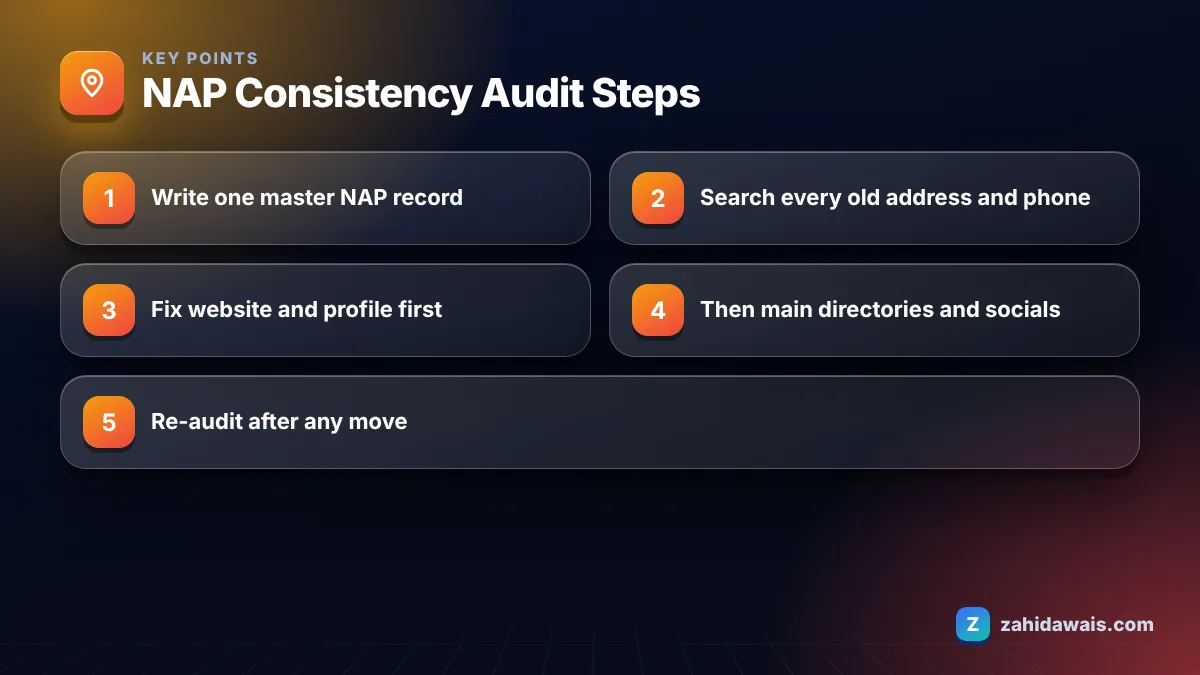
You find inconsistent citations by searching for every old version of your details, not only the current one. Old data is what causes the damage, so that is what you hunt for.
Paid citation tools can speed up the search, but the method is the same. For a small business with one location, a careful manual search often finds the important problems in an afternoon.
Fix the sources you control and the ones customers actually use before anything else. Not every directory deserves the same effort, and chasing tiny sites first wastes time.
| Source | Priority | Why |
|---|---|---|
| Google Business Profile | 1 | Shown directly in Search and Maps |
| Your website (contact page, footer, schema) | 1 | You control it fully and Google crawls it |
| Main social profiles | 2 | Customers check them and they rank for your name |
| Major national directories and maps apps | 2 | High visibility, often copied by smaller sites |
| Industry and association listings | 3 | Relevant to your field and often linked |
| Small or abandoned directories | 4 | Low impact, fix only if wrong data appears in searches |
Start with your website, because it is the source you control completely. Make sure the name, address and phone in the footer, the contact page and any LocalBusiness structured data all match the profile. My on-page SEO service handles this for clients.
When you cannot log in to a listing, claim it or contact the site owner, and only give up when neither works. Many directory profiles were created automatically or by a past agency, so nobody on your team has the password.
Never create a second listing on the same directory to get around a locked one. That simply adds a new inconsistency, and on Google itself a second profile breaks the one profile per business rule.
Keep the master record and the audit sheet after you finish. The next time you move or change your number, you will already know every place that needs updating, which turns a painful week into a single afternoon.
Your NAP should follow Google’s guidelines for representing your business first, and then be copied everywhere else. Getting the master record wrong just spreads the mistake.
If you are not sure what a term means, my SEO glossary covers citations, NAP and other local SEO terms.
A dental practice moved two years ago and changed its phone number. The audit found 31 listings. Of these, 9 showed the old address, 6 the old phone, and 4 used a longer name with “Teeth Whitening” added. The website footer still had the old number too. Priority order: website and Business Profile on day one, the 6 main social and national directory listings in week one, then the industry listings. The 7 abandoned directories with no login were noted but left alone. After the clean-up, the Google update alerts that kept restoring the old phone number stopped.
If you want this done for you, my local SEO services include a full citation audit and clean-up. You can also start with the free SEO audit checklist to check the website side first.
NAP stands for Name, Address and Phone number. In local SEO it refers to keeping these business details identical on your website, Google Business Profile, directories and social profiles. Some people add W for website and include hours or categories in the same check.
Google does not name NAP consistency as a ranking factor. It does say inaccurate business information can stop your profile showing for relevant searches, and that it may change your profile when it receives reports of inaccurate information. Consistency protects the correct details.
No. Common abbreviations describe the same address, and that is not the kind of inconsistency that causes problems. Focus on real differences, such as old addresses, old phone numbers and business names with extra keywords, which can confuse customers and Google.
Audit after any move, phone change or rebrand, and otherwise about once a year. Also check whenever Google changes a field on your Business Profile without your input, because that often points to old data still live on another website.
Google wants the phone number on your profile to be under the direct control of the business and does not allow numbers that redirect to other pages. If you use call tracking, keep your main local number consistent and get advice before changing it widely.
Yes. For a single location, searching old addresses, old phone numbers and your business name in quotes usually finds the important problems. Paid tools save time for multi-location businesses, but the priority is fixing your website and Business Profile first.
Facts checked against these official pages. Read how I check facts in my editorial policy.
Read the status, fix the missing proof, and retry with one clean attempt instead of many rushed ones.
Read article
Diagnose the cause from which reviews vanished and when, then fix how you collect reviews going forward.
Read article
If customers never visit you, Google expects your address hidden. Here is how to do it and set service areas properly.
Read articleSend your website and I will reply with a free audit.