Link building strategy
How to Get Backlinks Indexed by Google (Safely)
A link on a page Google has not indexed does little for you. Here is why linking pages go unindexed and the safe ways to help Google find them.
Read articleA new site needs a few trusted links, not a big package. This month by month plan shows what to build and when.
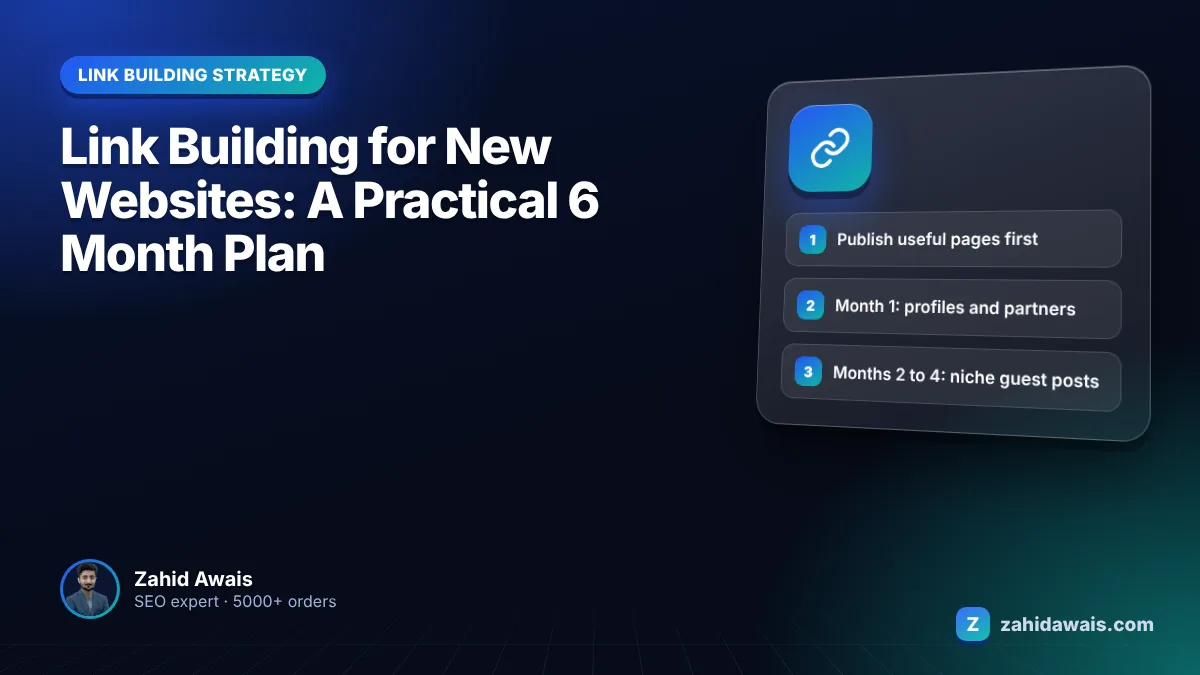
This article gives you a month by month plan for link building for new websites: what to do before any outreach, which first links are safe and useful, how many to aim for, and how to measure progress without expecting overnight rankings.
Link building for new websites should start once you have a handful of genuinely useful pages. Begin with foundation links such as business profiles, partners and local or industry associations, then add a few relevant guest posts and mentions each month. Avoid big link packages, PBNs and repeated exact-match anchors.
A new website should start light link building as soon as it has a few useful pages worth linking to, but not before. Links pointing at an empty or thin site rarely help and waste budget you will need later.
Google’s SEO Starter Guide notes that the vast majority of new pages Google finds every day are discovered through links, so a few early links help discovery. The same guide warns you can overdo promoting your site and actually harm it. That is the balance for a new site: enough links to be found and trusted, never so many that the pattern looks bought.
Before month one, make sure you have these basics in place:
If you are still building that foundation, my free SEO audit checklist covers the checks I run before any link work.
You get backlinks for a new website by starting with links you can legitimately claim, such as business profiles, suppliers, partners and associations, then earning or placing links on relevant sites through helpful content, guest posts and local or industry PR. Every link should have a reason to exist beyond SEO.
These are the sources I use for new client sites, roughly from easiest to hardest:
Avoid shortcuts. Google’s link spam policies list buying links for ranking purposes, excessive link exchanges, keyword-rich guest post anchors and automated link creation as violations. Paid placements are acceptable for advertising when marked with rel=”sponsored” or nofollow.
A new site needs roughly as many relevant referring domains as the pages currently ranking for its target keywords, which for many local and niche terms is a small number. Look at the specific pages ranking, not just their domains, and count unique linking sites.
In my experience across new client sites, 10 to 25 relevant referring domains in the first six months is a healthy, realistic range for a small business in a moderately competitive niche. Very competitive niches need more, and the timeline is longer. That range is my practical observation, not a Google figure.
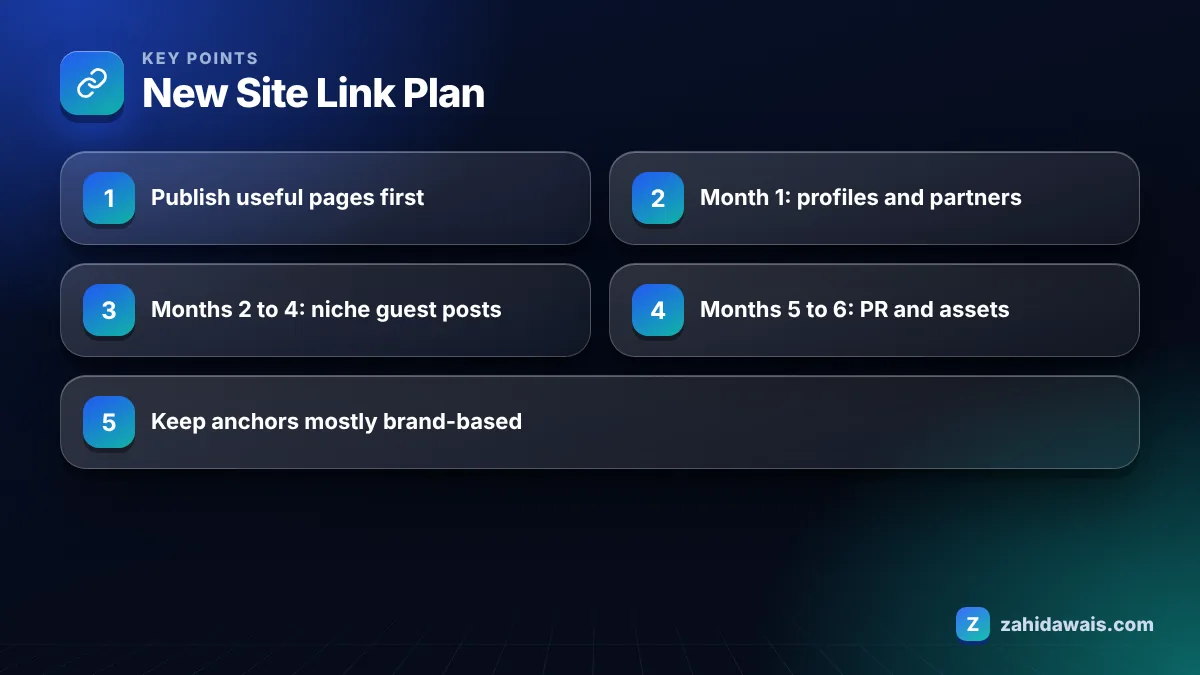
A sensible 6 month plan starts with foundation links, moves to relevant guest posts and resources in months 2 to 4, and adds PR or linkable assets in months 5 and 6, keeping volume modest throughout. This table shows the plan I use.
| Month | Focus | Target links | Anchor approach |
|---|---|---|---|
| 1 | Profiles, directories, partners | 4 to 6 | Brand and URL only |
| 2 | Associations, first 1 to 2 niche guest posts | 3 to 5 | Brand, URL, descriptive |
| 3 | Guest posts to service pages, founder interview | 3 to 5 | Add partial match |
| 4 | Publish a linkable asset; promote it | 3 to 5 | Descriptive asset names |
| 5 | Local or industry PR, resource page mentions | 3 to 6 | Brand and descriptive |
| 6 | Review results, double down on what worked | 3 to 6 | Rebalance if needed |
Spread links across the homepage, service pages and helpful articles. If every new link points to the homepage, service pages will struggle no matter how many links you add.
Here is a worked example for a new cleaning company in one city with a budget of about $250 per month. Month 1: Google Business Profile, 3 relevant local directories, and listings from 2 suppliers, all with the brand name as anchor (6 links, mostly free). Month 2: chamber of commerce membership and 2 guest posts on home and lifestyle blogs ($120). Month 3: 2 guest posts pointing to the “end of tenancy cleaning” page, plus a quote in a local news story about rental standards. Month 4: a free “moving out cleaning checklist” PDF, shared with 15 letting agents; 3 link to it. Months 5 and 6: 4 more relevant placements and 2 partner mentions. Total after 6 months: about 21 referring domains, every one with a reason to exist.
You measure progress on a new site by watching impressions and the number of queries a page appears for in Search Console, because those rise well before clicks and top positions do. A new site that gains impressions month after month is moving in the right direction, even if traffic is still small.
The monthly scorecard I share with new site clients has five lines:
Expect the first lines to move first. Impressions often climb during months 2 to 4, while positions and leads follow later. If impressions stay flat for three months despite indexed links, revisit content and intent before adding more links.
The biggest mistake new websites make is buying a large cheap package early, which usually brings irrelevant or network links that do nothing and may carry risk. Here are the others I see repeatedly in new client accounts:
The guide on guest posts vs PBN links explains why the cheap network option tends to fail. For full methodology, my link building guide covers site vetting step by step.
Patience matters too. The Starter Guide says some changes take effect in hours while others can take several months. A new site usually needs that longer window. If you want help building those first links, my link building services start with small, relevant placements suited to a new site, with honest reporting and no ranking promises.
Start with links you can legitimately claim: business profiles, relevant directories, suppliers, partners and industry associations. They are low risk, help Google discover the site, and build trust signals before you move on to guest posts and PR.
Buying links for ranking purposes violates Google’s spam policies unless the links carry rel=”sponsored” or nofollow. Sponsored placements can still bring traffic and visibility. Cheap bulk packages for new sites usually come from irrelevant or network sites and rarely help.
There is no fixed timeline. Google says some changes take effect in hours while others can take several months. For a new site in a moderate niche, meaningful movement often takes several months of content and steady, relevant link building.
Early foundation links naturally point to the homepage. After that, spread links across service pages and helpful articles. Pages you want to rank usually need some links of their own, plus strong internal links from the homepage.
Social profile links are usually nofollow and carry little ranking weight, but they help people find and trust a new brand and can drive early visitors. Set up the profiles you will actually use and link your website from each one.
Google does not set a number. Problems come from link schemes, such as paid links without the right attributes, private networks or automated tools. A new site gaining many genuine links from a news story is fine; a bought package of hundreds is not.
Facts checked against these official pages. Read how I check facts in my editorial policy.
A link on a page Google has not indexed does little for you. Here is why linking pages go unindexed and the safe ways to help Google find them.
Read article
Most sites never need the disavow tool. Here is how to spot genuinely harmful links, when Google says disavowing makes sense, and how to build the file correctly.
Read article
There is no magic number of links per month. What matters is whether your link growth looks like the way real sites earn links. Here is how to plan a safe pace.
Read articleSend your website and I will reply with a free audit.